DeepSeek has released V4.1-Flash, a new model in its V4 architecture family that the company says combines native visual understanding with faster inference and lower API pricing. The model is available now through the DeepSeek API as deepseek-flash, giving developers a new default option for workloads that need to process text and images while managing throughput and cost.
The release is more than a routine alias change. DeepSeek describes V4.1-Flash as the smallest member of a new architecture family, built around a causal encoder-decoder design. The company lists 552 billion total mixture-of-experts parameters, with eight billion active for input and 16 billion active for output. As with other MoE systems, total parameter count does not describe every token's computation; the active-parameter figures are relevant to the model's serving profile.
Native multimodal support joins the API
The practical change for developers is native visual understanding in the new API model. DeepSeek says V4.1-Flash is live with multimodal support, positioning it for applications that need to interpret images alongside text rather than sending visual work to a separate endpoint. The announcement does not remove the need for application-level validation. Teams should test representative images, ambiguous inputs and operational failure cases before assigning the model a decision-making role.
DeepSeek also presents the model as an efficiency-oriented release. It says the new architecture uses a smaller KV cache than the prior generation, claiming one-quarter of the HBM and one-eighth of the SSD storage. KV-cache economics can be significant for long-running or repeated-context applications, because cache reads often make up a meaningful share of an agent's total spend. The company's claims should be treated as an invitation to benchmark actual workloads, not as a universal guarantee for every prompt length and traffic pattern.
Pricing and migration are part of the announcement
New pricing took effect at 04:00 UTC on 10 September, according to DeepSeek. The company retains peak and off-peak pricing, with off-peak rates set at half of peak rates. That makes scheduling and request timing more relevant for customers able to move flexible batch work outside high-demand periods. It also means teams should update internal cost models rather than assume a single published price captures their average spend.
DeepSeek has announced a migration path for previous Flash variants. V4-Flash and V4-Flash-Vision-Exp are retired, while the compatible names deepseek-v4-flash and deepseek-v4-flash-vision-exp temporarily route to V4.1-Flash. This offers a softer transition, but compatibility routing should not be mistaken for unchanged behaviour. Model updates can alter instruction following, formatting, tool use and image interpretation even when an existing integration continues to receive responses.
V4-Pro is also being redirected
The company says that from 04:00 UTC on 14 September, requests made to deepseek-v4-pro will route to V4.1-Flash at V4.1-Flash rates until V4.1-Pro arrives. That is a material operational notice for teams using the Pro identifier. They should run evaluation suites before the switchover, record baseline outputs and check any tasks where model choice affects compliance, customer-facing copy, code generation or automated actions.
Redirecting a higher-tier model name to a new Flash release may simplify availability while DeepSeek prepares the next Pro model, but it makes API version governance especially important. Production owners should verify model IDs in configuration, monitor latency and error rates after the date, and retain a rollback plan where their application permits it. If prompts depend on a particular reasoning style or output format, regression testing is more useful than relying on model-family names.
Performance claims need workload testing
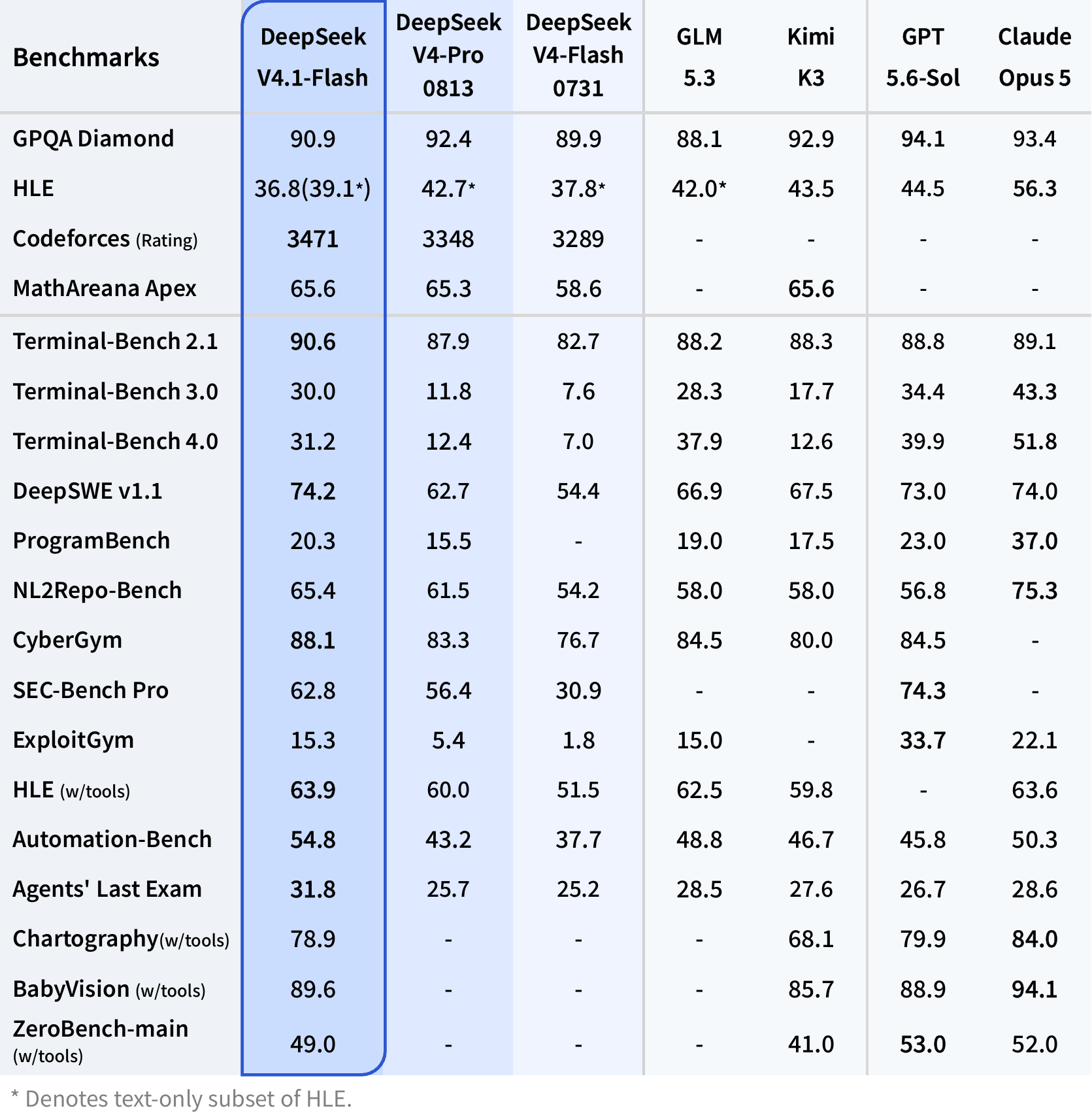
DeepSeek says external testing places V4.1-Flash ahead of V4-Pro on performance, cost, speed and total runtime, and notes partner support from WorkBuddy, CodeBuddy and OpenCode. Those claims indicate the intended use cases: interactive agent work, coding and API-backed automation where total job duration matters. They are not a complete measure of model fitness for a particular organisation. Benchmark choice, tool harnesses, prompt construction and the definition of a completed task can all change the result.
The announcement also suggests that DeepSeek is using V4.1-Flash as a bridge between legacy Flash endpoints and a future V4.1-Pro. That makes the release immediately relevant both to new API customers and to existing users whose identifiers will be routed automatically. It is a product release with a pricing change, a multimodal capability and a defined migration deadline, rather than merely a research preview.
What developers should do next
Developers should begin by confirming which identifier their integration sends, then test text-only and image-bearing requests against saved examples. Cost reviews should distinguish peak from off-peak traffic, cache behaviour and any effects of a changed model on retries or human review. Teams using deepseek-v4-pro have the clearest deadline: validate V4.1-Flash before the stated 14 September routing change.
DeepSeek's V4.1-Flash release offers a lower-cost, vision-capable API option while signalling a transition in its V4 line. The value for each customer will depend on measured output quality and operational fit, but the migration terms mean it deserves attention now rather than after an identifier changes behaviour in production.