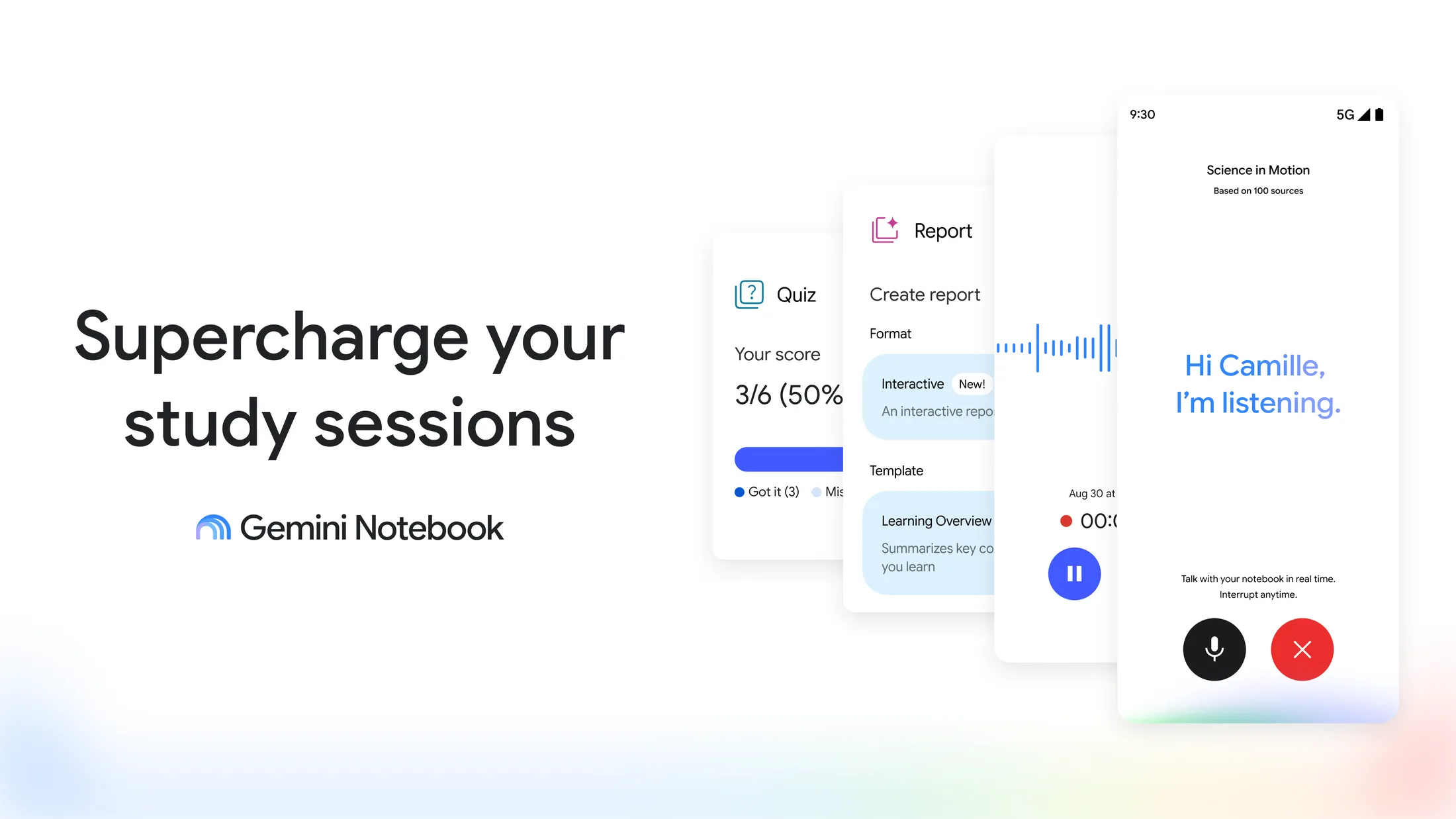
A notebook that can talk back
Google has announced a set of study features for Gemini Notebook, including real-time spoken conversations about a user’s own sources. The Google announcement, published on 15 September, also describes an audio recorder for the mobile app, interactive learning overviews, additional quiz formats and short video summaries. The tools have different rollout dates and eligibility conditions; they should not be treated as one universal launch.
The central idea is to turn a collection of notes and readings into an active study space. A student can ask a question aloud, interrupt an explanation and request a different route through a difficult concept. Google says responses in the spoken experience are grounded in the notebook’s sources, which may make it easier to trace an explanation back to the material being studied.
Speech changes the study rhythm
The announced mobile conversation feature is planned for nearly 100 languages. Google’s footnote says it begins with eligible Google AI Ultra subscribers aged 18 or older, with Pro and other users coming later. That is an important distinction for anyone deciding whether to change a plan or recommend the feature to a class: a product demonstration does not mean every student can access it immediately.
Speaking a question can be helpful when the barrier is not finding a document but articulating what is confusing. A student might ask why one step in a proof follows another or request an explanation of a diagram while walking through notes. A useful answer still needs to match the assigned material, and the student should inspect citations rather than accept fluent speech as confirmation.
Voice interfaces also need a way to recover from misunderstandings. If a term is misheard, the user should be able to see what the system interpreted and correct it. This is especially relevant for names, equations and technical vocabulary, where a small recognition error can change the question.
Capturing and organising material
Google says a mobile audio recorder will be available starting the following week, allowing students to capture lectures or their own thoughts alongside existing notes and sources. The announcement says this supports web and mobile users, including those under 18, when English is selected as the output language. The exact permission to record a class or another person is a separate matter for the student and institution to resolve.
The value of recording is not merely storage. The student can bring spoken material into the same notebook as handouts, photographs and handwritten notes, then ask questions across them. That may reduce the gap between hearing an explanation and remembering where it fits. Yet a recording can contain mistakes or incomplete context; putting it into a notebook does not automatically make it authoritative.
A sound workflow would label each source with its origin and date. Lecture notes, a course text and a student’s own interpretation should remain distinguishable. When an answer combines them, the reader should be able to inspect which material supports the conclusion.
Overviews, quizzes and videos
Interactive learning overviews are intended to weave together summaries and generated study materials such as quizzes, flashcards and infographics. Google says the overviews will reach all users over the following weeks. More quiz formats, including short answer and fill-in-the-blank, are also coming soon. Those future-tense details should not be described as fully available on the publication day.
Students will be able to ask follow-up questions about completed quizzes and flashcards, and edit the questions. That control is useful because a generated quiz can overemphasise easily testable facts while missing a course’s deeper learning goal. The ability to revise the material allows a teacher or student to align it more closely with the actual syllabus.
Google also describes roughly one-minute Short Video Overviews in more than 80 languages. A compact video may make a formula or process easier to revisit, but it is an aid to understanding, not a substitute for working through the underlying problem. A polished animation can conceal an oversimplification unless the learner checks it against the source.
Plan and regional qualifications
The announcement includes student subscription offers: a year of Google AI Pro for eligible US college students and a Google AI Plus offer in more than 140 markets outside the US. Eligibility exclusions, payment conditions and later charges are in the offer terms. Australian students should verify the current local terms before assuming the international offer applies to a particular account.
The stated higher usage limits concern the relevant plan and are not evidence that the tools improve learning outcomes. An institution considering adoption should test accessibility, accuracy, source control and the time teachers spend correcting generated materials.
The update is material because it makes Gemini Notebook more interactive across voice, captured audio and study outputs. The practical test is whether those interactions help a student understand and retain concepts while keeping the sources visible. Staged rollout, language settings and plan rules remain part of the announcement, not fine print to omit.