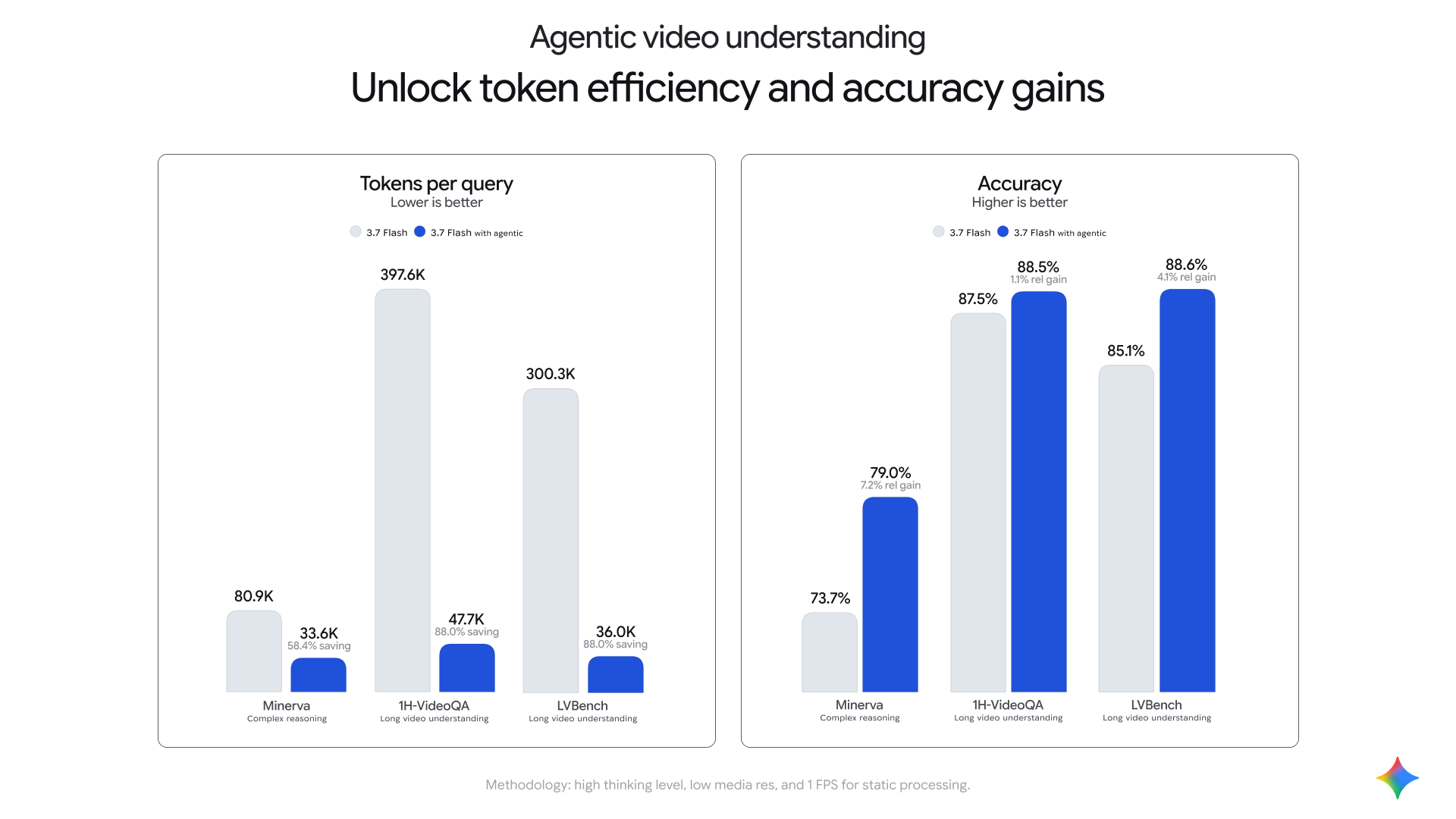
Google has introduced agentic video understanding for Gemini, a new API capability that changes how supported Gemini models analyse video. Rather than treating an entire clip as a stream to be processed at a fixed rate, the system can search for the relevant moments and inspect them more closely. Google says the feature is available now for video uploads and YouTube videos through Google AI Studio and the Gemini Enterprise Agent Platform.
The launch covers Gemini 3.7 Flash, Gemini 3.6 Flash and Gemini 3.5 Flash-Lite. Developers enable it by setting video processing to agentic in the API configuration. Google says it uses ordinary Gemini API token pricing and does not add a separate feature charge.
From fixed sampling to targeted inspection
Video models have traditionally faced a blunt trade-off. Processing at a high frame rate can preserve more detail, but it consumes more tokens and raises cost. A lower rate makes long recordings cheaper to handle, but can skip a short action, a visual change or the exact point at which an anomaly appears. Google describes its earlier static approach as ingesting video at a fixed frames-per-second setting, with one frame per second as the default.
Agentic video understanding instead combines the model’s reasoning with native video tools. In response to a request, Gemini can decide which segment to load, whether to inspect visual frames, audio or transcript material, and when a closer look is needed. The point is not that every clip is watched in maximal detail; it is that the model can spend its processing budget where the question demands it.
That distinction matters most for long material. A developer examining a multi-hour recording may need an answer about a brief event rather than a synopsis of every minute. Google positions the capability for sub-second moment retrieval, long-form search, anomaly detection and counting actions or objects. Those are tasks where a fixed sampling schedule can either miss the event or force an expensive whole-video pass.
Google’s efficiency claims need workload context
Google reports reductions of up to 88 per cent in token consumption and up to 66 per cent in analysis cost across its standard video benchmarks, alongside accuracy gains of up to 7 per cent. The company says Gemini 3.7 Flash offers the strongest overall quality and cost-efficiency combination among the tested models. These are vendor-reported benchmark results, so teams should validate them against their own footage, prompts and latency requirements before using the figures for capacity planning.
Even so, the design suggests a practical benefit for workloads where much of a video is irrelevant to a single question. Compliance-review teams may need to identify a specific interaction in a long recording. Media operations may need to locate a cut point or verify a count. Safety and industrial applications may need to resample a suspicious interval at a higher frame rate. In each case, the ability to revisit the promising part of a video is more useful than a uniform scan alone.
Availability spans developer and enterprise entry points
The feature is exposed through the Gemini API in both Google AI Studio and the Gemini Enterprise Agent Platform. That gives individual developers and organisations a common configuration concept, even if their surrounding governance, billing and deployment arrangements differ. Google also says the capability will roll out to Gemini app users on Flash and Flash-Lite models, and that it is planned to support YouTube’s Ask YouTube experience in coming months.
For API users, the immediate work is relatively small: select a supported model, provide the video URI and set processing to agentic. The operational work may be larger. Teams should decide which questions are suitable for agentic inspection, measure results on representative clips, and retain a way to audit answers that affect editorial, safety or business decisions. A model finding a moment is not the same as an independently verified conclusion about what occurred there.
Input handling also deserves attention. The launch supports uploads and YouTube videos, but organisations still need to apply their own rules around consent, retention, sensitive footage and who can access outputs. The announcement describes the processing feature, not a replacement for those controls. Enterprises using recordings with personal, health, security or confidential business information will want to confirm their Gemini configuration and contractual terms before scaling use.
A shift in the economics of long-video questions
The practical significance of this release is less about a new label for video analysis than about moving some navigation decisions inside the model loop. Previously, a development team that wanted dynamic video inspection often had to build its own orchestration: sample broadly, retrieve candidate segments, rescan them at a different rate and combine results. Google says Gemini can now perform a version of that loop using an internal video tool.
That could reduce implementation work as well as token consumption, particularly for applications built around recurring questions over lengthy footage. It does not remove the need for good prompts, domain tests or human review where the stakes are high. It does give Gemini developers a more direct route to asking a model to investigate a recording rather than merely consume it at a predetermined pace.
Google’s September release also reinforces the direction of the Gemini platform: native multimodal models paired with tools that can choose how to inspect the underlying material. For builders, the next useful test is concrete: compare a current fixed-rate workflow with agentic processing on the actual videos and questions that matter to the product. The resulting accuracy, cost and response-time measurements will be more informative than any headline benchmark.