AI infrastructure needs more than chips
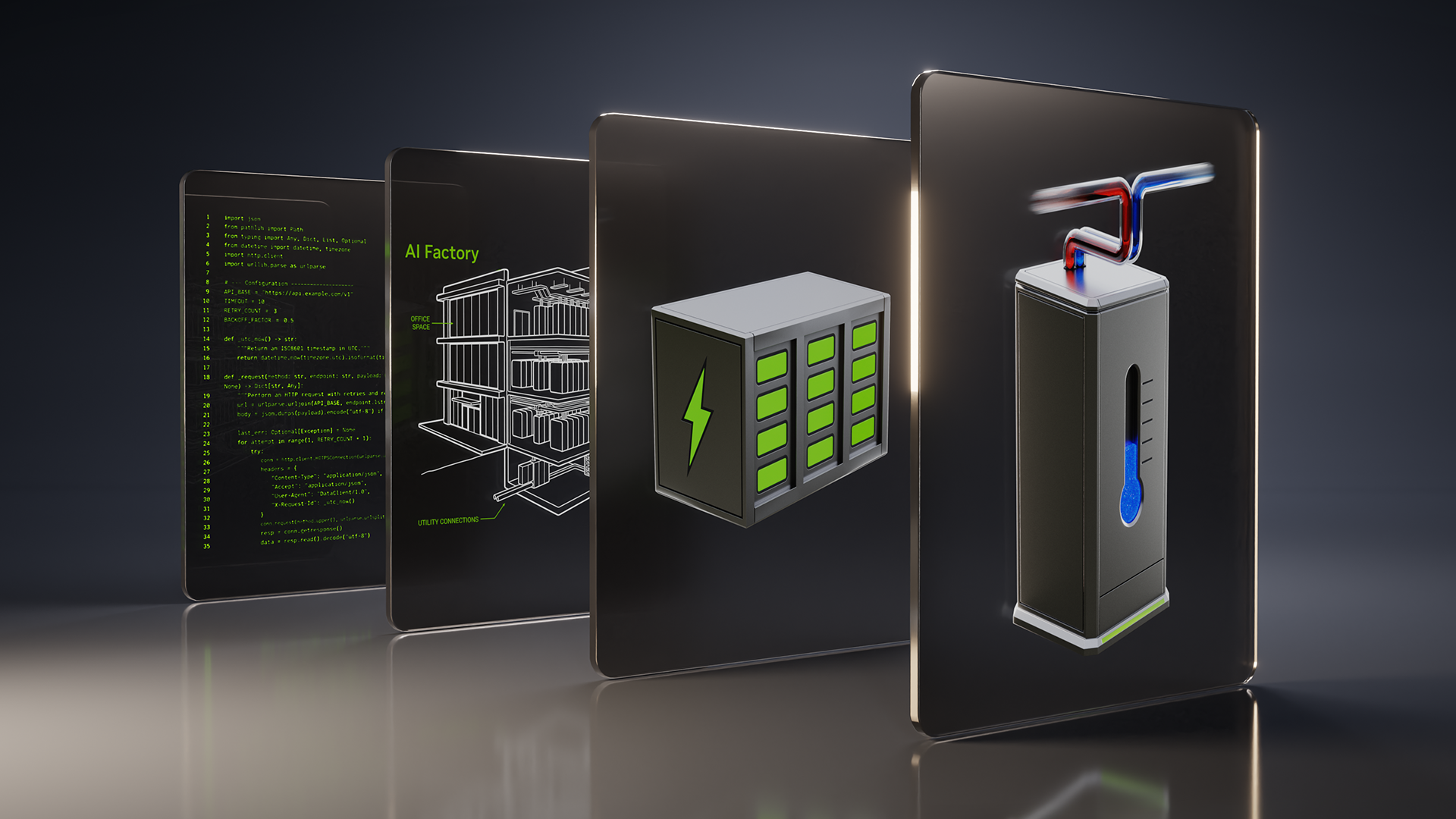
NVIDIA has launched DSX Ready, a programme to qualify partner products against applicable requirements in its DSX AI-factory reference designs. The NVIDIA announcement, published on 21 September, starts with battery energy storage systems and cooling distribution units. It is a practical infrastructure announcement: an AI factory cannot deliver useful compute if power and cooling cannot support the equipment reliably.
DSX is NVIDIA’s framework for designing and operating the wider factory across compute, networking, software, facilities, power and cooling. DSX Ready links that design to specific partner offerings. The qualification is intended to give builders a clearer way to find components that meet category requirements, while giving suppliers a defined route to demonstrate conformance.
The first two categories
At launch, NVIDIA names battery-system offerings from Hitachi Energy, LG Energy Solution and Tesla, and cooling-distribution offerings from LG Electronics, LiquidStack and Vertiv. These are different parts of the infrastructure problem. A battery system can buffer or manage power, while a cooling distribution unit moves heat away from liquid-cooled computing equipment.
NVIDIA says battery providers run required tests and submit supporting data for review and approval within a defined qualification boundary. Cooling-distribution providers use a self-qualification suite to check applicable functional requirements. Those paths are not identical, and a buyer should confirm exactly which product, version and configuration has qualified rather than assuming every item from a named vendor carries the designation.
The initial list also does not mean alternative suppliers are unsuitable. A qualification programme is a route to evaluate products against one reference-design ecosystem. Procurement still involves performance, maintenance, local service, cost, warranties and how a particular facility is built.
Why a product pass is not a site pass
NVIDIA explicitly warns that battery qualification does not replace site-level engineering or imply site-level stability. That caveat is essential. A storage system that passes a product test can still be poorly matched to a site’s grid connection, protection systems or operating pattern. The same is true of a cooling unit that meets a functional requirement but is undersized or awkwardly integrated into a particular plant.
AI-factory design has linked constraints. More compute can raise heat load; a new cooling architecture may change water or electrical demand; local grid limits can reduce the amount of hardware a site can run. Optimising a single component in isolation can simply move the bottleneck. DSX Ready may make the interfaces clearer, but it cannot make the engineering trade-offs disappear.
For a project team, the useful procurement question is what evidence the designation supplies and what remains to be verified in commissioning. Documentation should identify test conditions, boundary assumptions and any changes that invalidate the qualification.
A qualification checklist for buyers
Before adopting a qualified component, a buyer should request the exact model identifier, firmware and tested operating envelope. They should ask how the product behaves during loss of a feed, a sudden load change and routine maintenance. The answer may reveal whether the qualification covers the conditions most likely to stress the planned facility.
The builder should also document interfaces between vendors. A cooling unit may satisfy a reference requirement yet depend on a site control system configured by another contractor. A battery system may be capable of a useful response but need coordination with grid protection and generators. Clear ownership of each interface turns a qualification badge into a credible engineering input.
Commercial due diligence remains separate. Builders need support commitments, spares, change notices and a plan for replacing a component without breaking the validated design. A qualification may help narrow choices, but the operating life of an AI factory is much longer than a launch announcement. Maintaining evidence after upgrades is part of the procurement decision. It is especially important where several suppliers must coordinate an emergency response under a single site operator with clear accountability and tested procedures.
How builders should use the signal
A data-centre builder could use DSX Ready to shorten an initial shortlist, then compare the qualified offerings against site-specific loads and operating scenarios. That includes a peak inference surge, planned maintenance, equipment failure and the actual regional climate. Power and cooling resilience should be demonstrated together, not in separate marketing specifications.
NVIDIA says further infrastructure and software categories will follow. It has not presented a complete approved bill of materials for every AI factory, and future categories should not be reported as already available. Partners seeking qualification are directed to the relevant NVIDIA team and category requirements.
The announcement matters because it creates a visible bridge between an AI-factory reference design and named physical products. As spending on accelerated computing grows, integration risk becomes as consequential as chip performance. DSX Ready offers a useful starting signal, provided buyers keep the designation in its proper scope and retain independent responsibility for the finished facility.