
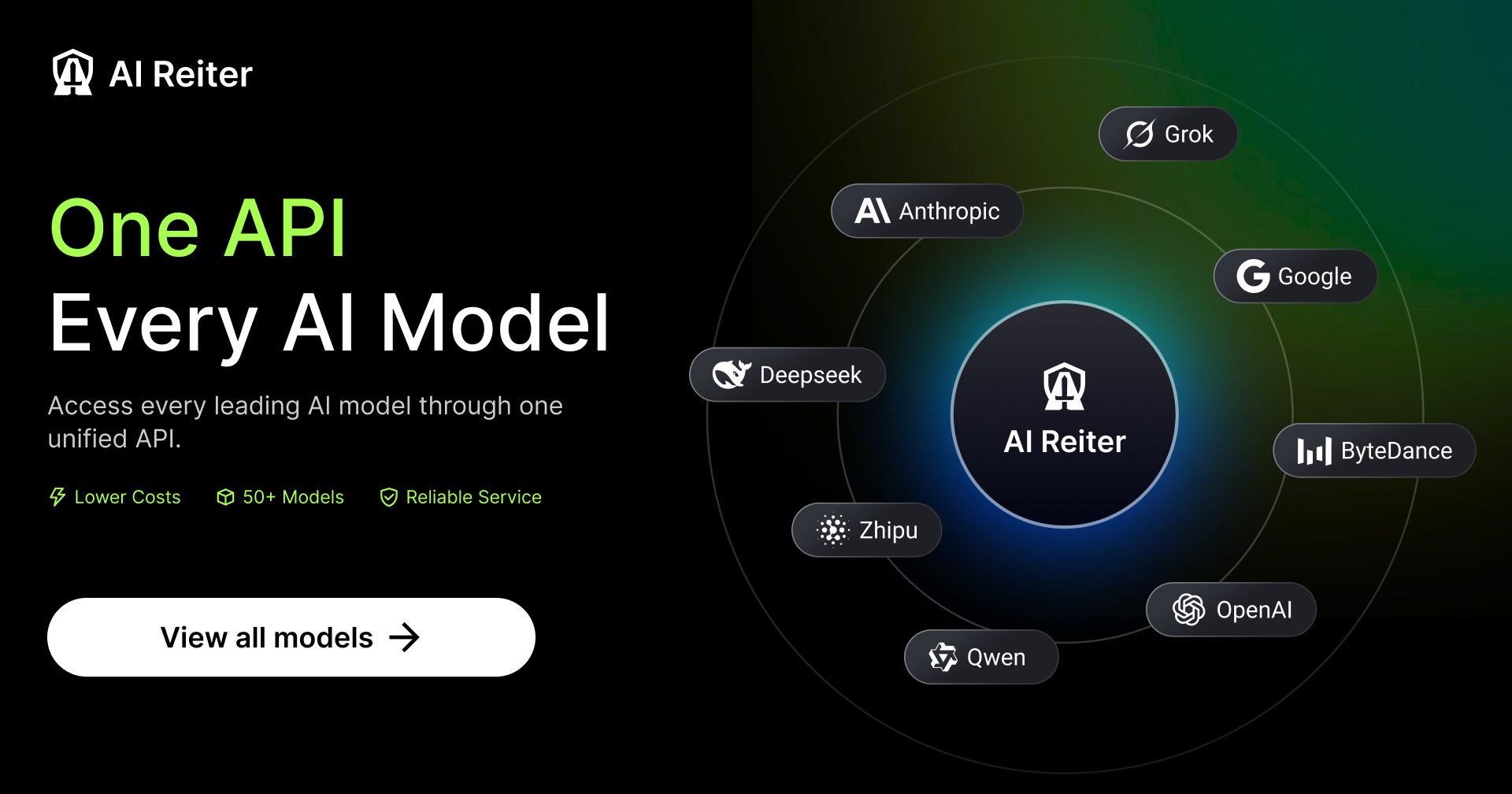
AIReiter brings a broad catalogue of generative models into one developer account, API and browser playground. Instead of opening separate accounts with every model provider, a team can fund one credit balance, use one key and call text, image, video and audio models through a shared workflow. The platform also sells a separate Coding Plan for tools such as Claude Code, Codex, opencode and Cline.
What AIReiter offers
The core service is a pay-as-you-go model gateway. Developers can compare model-specific prices, test inputs in the playground and then use the corresponding model ID through the API. Image and video pages expose production controls such as resolution, duration, aspect ratio, reference media and audio where supported. Chat models use token pricing, while media models may charge per image, output second or generation.
- One API key and billing balance across text, image, video and audio models
- Browser playgrounds for testing prompts and model parameters
- OpenAI-compatible and model-specific API workflows
- Per-model pricing tables with the charge shown before media generation
- Reference-image, image-to-video, video-extension and editing workflows where supported
- Usage tracking, credit controls and public service-status information
- Reusable templates for common generative-media tasks
- A separate fixed-price Coding Plan for compatible coding agents
Model range
The catalogue changes regularly and includes models attributed to providers such as OpenAI, Anthropic, Google, xAI, ByteDance, Alibaba, MiniMax, Moonshot AI, DeepSeek, Black Forest Labs and Kling. Current examples include GPT and Claude chat models, GPT Image, FLUX and Qwen image models, and Seedance, Kling, MiniMax, Vidu, Wan and Veo video options.
Availability through an aggregator does not make AIReiter the developer of those underlying models. Buyers should check the model ID, provider route, supported parameters and data terms for the exact endpoint they intend to use. The company says coding-plan responses identify the model that served them and are not silently substituted with a different model.
Pay-as-you-go pricing
The main API has no subscription tier requirement. Credits are deducted according to the selected model and operation, with 100 credits corresponding to US$1 in the published tables. Rates vary substantially. At the time of review, FLUX.2 Pro was listed at $0.05 for a 1K image and $0.07 for 2K; MiniMax H3 Turbo was $0.015 per generated second at its default 768P setting or $0.03 in high-quality mode; Wan 3.0 ranged from $0.04 per second at 480P to $0.16 at 1080P. The live pricing page should be treated as the source of truth because models and rates change.
Media billing can include more than the visible output. Some video-editing and reference-video modes charge for input duration as well as generated seconds, while particular image or audio references may be free. AIReiter displays the applicable charge before submission, so teams should validate a representative job rather than compare only the headline rate.
Coding Plan
The Coding Plan is billed separately from the pay-as-you-go balance. Its published monthly prices are Go at $20, Plus at $50 and Pro at $100. An early-bird offer running until 25 December 2026 reduces Go to $10 and Plus to $30 for customers who maintain their subscription; Pro remains $100. Annual early-bird prices are $99, $299 and $999 respectively.
Go centres on Claude Sonnet 5.5, Plus adds higher limits and Claude Opus 5.5, and Pro adds the largest allowances and Claude Fable 5.1. Other GPT, Gemini, Grok and open models are included. Allowances are measured using official API prices and are subject to shared account limits plus per-model five-hour, weekly and monthly caps. There are no automatic overage charges: requests return a rate-limit response until a cap resets, unless the customer upgrades or uses a separately purchased reset card.
Data and content considerations
AIReiter’s privacy policy says payment processing uses Stripe, authentication uses Clerk and traffic analysis uses Google Analytics. It also says generated content may be publicly visible by default in a future Explore area unless the user marks it private. Anyone uploading confidential source material should verify the current visibility controls, retention rules and the downstream model provider’s terms before production use.
Our take
AIReiter is most useful for developers and creative teams that want to experiment across many model families without maintaining separate integrations and balances. The transparent, model-by-model tables are a strength, particularly for video where duration and resolution can change the economics quickly. The trade-off is another vendor layer between the customer and the original model provider. Teams should test latency, parameter parity, support and data handling with their own workload, then compare the total routed price with direct provider access. The Coding Plan may suit heavy agent use, but its overlapping account, model and time-window caps need to be understood before relying on it for continuous production work.