
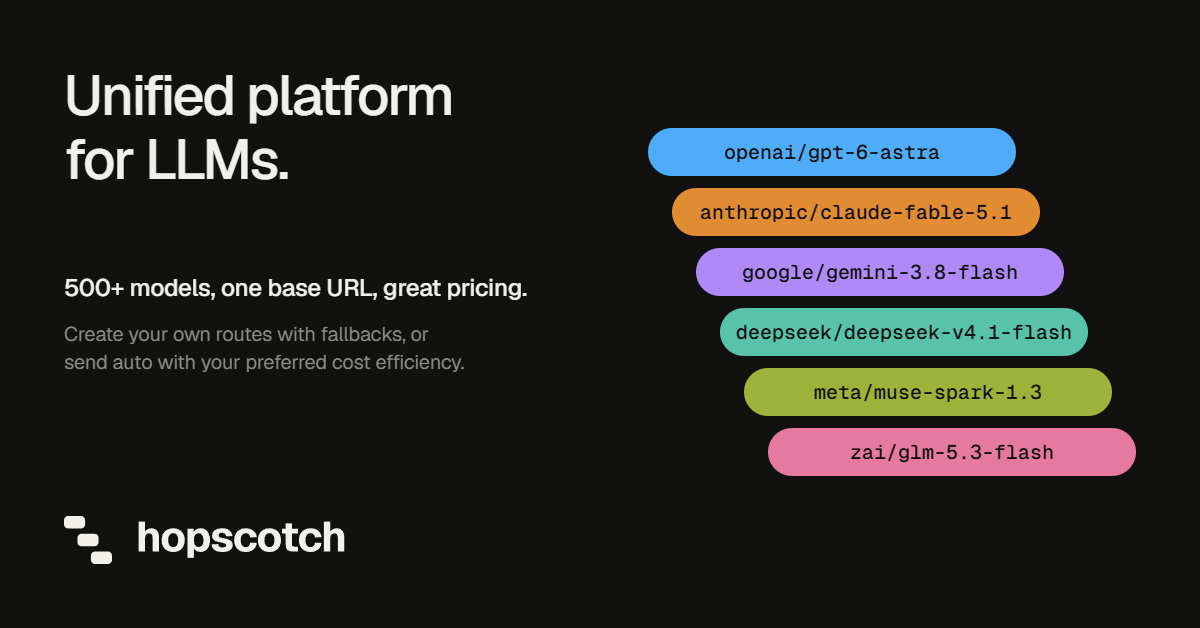
Hopscotch is an OpenAI-compatible gateway for teams that use several large language model providers. It replaces multiple provider integrations with one API key and endpoint, while adding budget controls, fallbacks, request logs and usage analytics. Its model catalogue covers major commercial and open model families, making it possible to change routes without rewriting the application around a different SDK.
Core capabilities
- A single OpenAI-compatible API across a broad catalogue of text models
- Spend limits by API key, teammate and workspace, including time-based controls
- Ordered fallback models when a preferred route fails
- Request logs showing model, provider, tokens, cost, latency and outcome
- Usage analytics for comparing expenditure, speed and failures
- A playground for testing one prompt on up to three models
- Bring-your-own-key routing with Hopscotch controls and tracking
- Guardrails intended to stop risky requests before they reach a model
Models and routing
The live catalogue spans models from providers including OpenAI, Anthropic, Google, DeepSeek, Meta, Mistral, Moonshot AI and others. Hopscotch is the routing and control layer rather than the developer of these models. Availability, context windows, model behaviour and data terms still depend on the chosen provider route, so production teams should validate the exact model identifier and not assume every provider feature is reproduced by the common interface.
Bring your own key is available without a Hopscotch platform fee: the underlying provider bills the organisation directly, while Hopscotch supplies its limits and observability. The hosted-credit route charges the provider's published token rate without an additional model markup according to the company.
Pricing
Pay-as-you-go access starts with a US$5 credit purchase and deducts each model's listed usage price. Hopscotch also advertises limited passes for its first 1,000 users. Starter costs US$20 per seat each month and includes up to US$40 of model use, Growth costs US$50 with up to US$100 and Pro costs US$200 with up to US$400. The headline allowance is governed by rolling caps: Starter allows US$3 per five hours and US$10 per week, Growth US$5 and US$25, and Pro US$15 and US$100. Unused included use does not roll over.
Once an included allowance or time-window cap is reached, further activity may draw from purchased credits subject to the account's limits. Enterprise arrangements are custom. The passes are a promotional offer rather than a permanent doubling of cash value, so buyers should model their normal request pattern against the five-hour and weekly controls before choosing one.
Privacy and operational fit
Hopscotch says zero data retention is the default and that prompts and responses are not stored. Request metadata is retained for logs and analytics, so regulated teams should still confirm the current data-processing agreement, provider-specific handling and whether their selected model route offers the controls they require.
Our assessment
Hopscotch is a practical option for startups, agent builders and internal platform teams that want model choice without giving up cost governance. The combination of per-key budgets, route fallbacks and comparable logs addresses operational work that otherwise has to be built around raw provider APIs. Its OpenAI-compatible surface should make early integration relatively straightforward.
The main trade-off is dependence on an additional routing service. Teams should test streaming, tool calling, structured outputs, error handling and latency with the models they actually use. High-volume buyers should also compare hosted rates and promotional caps with direct provider contracts. Bring your own key offers a useful middle course when an organisation wants Hopscotch's controls but needs a direct commercial relationship with the model provider.